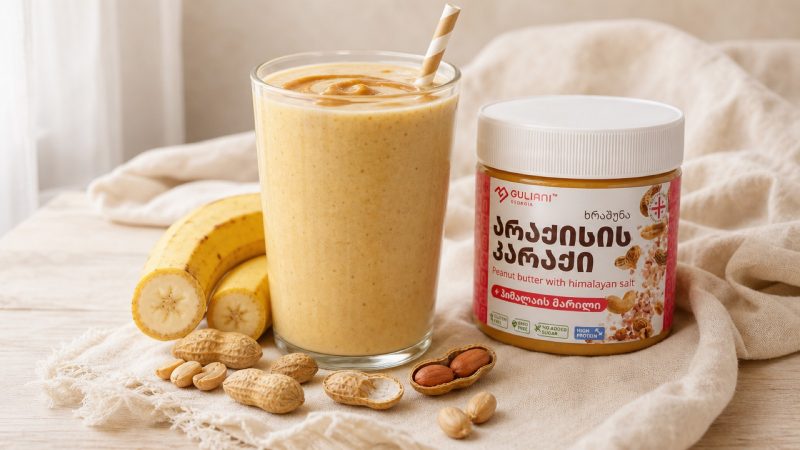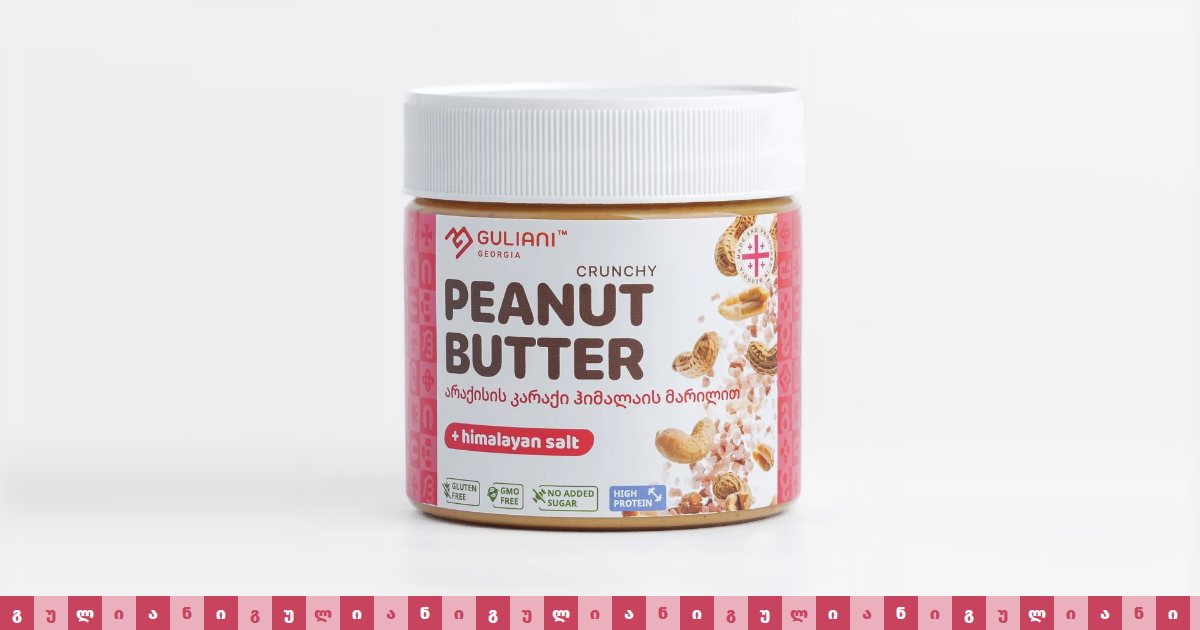
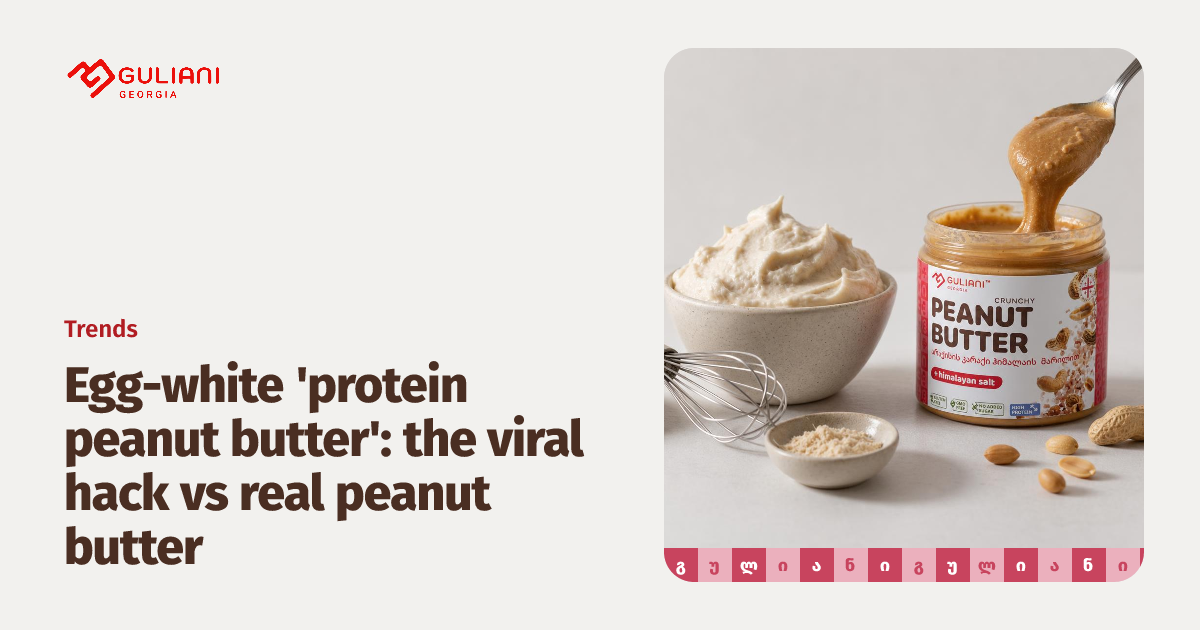
A new trick is doing the rounds on social media. You whisk peanut flour with egg whites or protein powder and get a thick, creamy spread that tastes like peanut butter [1]. People love it because it has much more protein and less fat and calories than regular peanut butter [1]. We make real peanut butter every day in Tskaltubo, so we want to look at this trend calmly and honestly. What do you actually end up with, and how do the taste and ingredients differ? We will also show you how to make a protein cream with ordinary khacho (Georgian cottage cheese) or matsoni, with no raw egg whites and no powders.
Where the trend came from: peanut flour plus egg whites
The recipe was published on 22 October 2026 by the Healthy Helper blog, in three high-protein versions at once [1]. The idea is simple. Peanut flour is the base, and egg whites or protein powder give it a creamy texture [1].
The timing is no accident. According to Circana data, about 48% of US adults are trying to add protein to their diets, up 7 points from last year [2]. Weight-loss drugs are named as a big reason demand is growing [2]. Shelves already carry protein Doritos, Babybel, protein pudding and meat sticks [3]. Aldi is launching protein pancakes in October [2]. Against that backdrop, 'protein peanut butter' rode the wave perfectly.
Comparing 36 g: protein, fat, calories, taste and ingredients
36 g, roughly two good spoonfuls, is the portion printed on our jars. Let's use it as the yardstick.
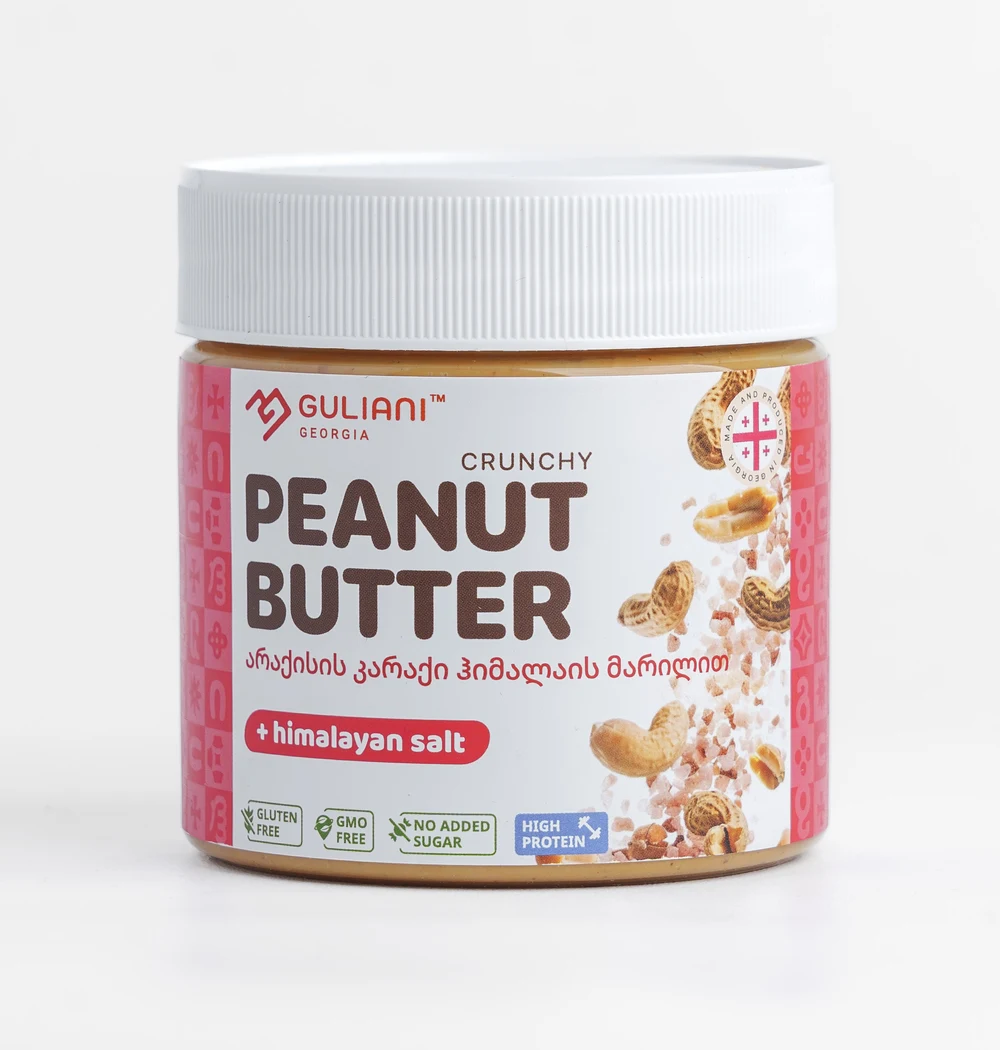
- Ingredients. Peanut Butter Classic has just two: roasted peanuts and Himalayan salt. The viral version is peanut flour plus egg whites or protein powder [1].
- Protein. A 36 g portion of Classic gives 9.6 g of protein. The hack contains more [1]. The exact figure depends on the brand of flour, the powder and the proportions, so we won't invent a number.
- Fat and calories. A portion of Classic is 232 kcal. The hack has less fat and fewer calories [1], and that is its main selling point.
- Taste and aroma. This is where the biggest gap lies. Our owner explains it below.
Customers ask us about protein all the time. The owner of GULIANI puts it this way: “Customers often pay attention to protein. Our particular pride is that our Crunchy peanut butter has about 27 grams of protein per 100 g, the highest figure among local producers.”
On peanut flour he says: “Peanut flour is a great alternative in terms of protein, but not in taste and aroma. After roasting, we turn the peanuts into butter almost immediately to keep all of that as much as possible.”
In short, the hack wins on numbers. Real peanut butter wins on taste, simplicity and a short ingredient list. Both have their place, but one is not a full replacement for the other.
Why not everyone needs raw egg whites and powders
We are not doctors and we are not here to scare anyone. Still, a few common-sense points are worth making:
- Raw egg white isn't for everyone. In many Georgian homes eggs are only eaten boiled or fried, and that is a perfectly normal choice. If raw egg white doesn't appeal to you, simply skip that version of the hack.
- A powder means one more tub and one more label. Shoppers are now looking harder at protein claims on packaging [2]. If you buy a powder, read the ingredients carefully.
- “More protein” is not a goal in itself. How much you need depends on your weight, activity and goals. For a rough guide, try our daily calorie calculator, which also shows a protein, fat and carb split.
- Everyday ease. You open the jar, spread it and you're done. The hack needs whisking every single time.
Our version: protein cream with peanut butter and khacho or matsoni
“I eat peanut butter with khacho all the time. It's a great flavour combination and a protein boost, especially after training,” says the owner of GULIANI. This is our answer to the viral hack. No flour, no powder and no raw egg whites, only what you probably already have in the fridge.
- Put 3–4 tablespoons of khacho in a bowl. If it's on the dry side, add a little matsoni.
- Add 1 heaped spoon of Peanut Butter Classic. For a sweeter cream, use Peanut Butter with Honey or Peanut Butter with Coconut.
- Whisk with a fork or a small blender until smooth.
- Adjust the thickness with matsoni. Use less for a thick spread for bread, or more for a sauce to go with fruit.
- Finish to taste with cinnamon, sliced apple or banana, or a few crushed walnuts.
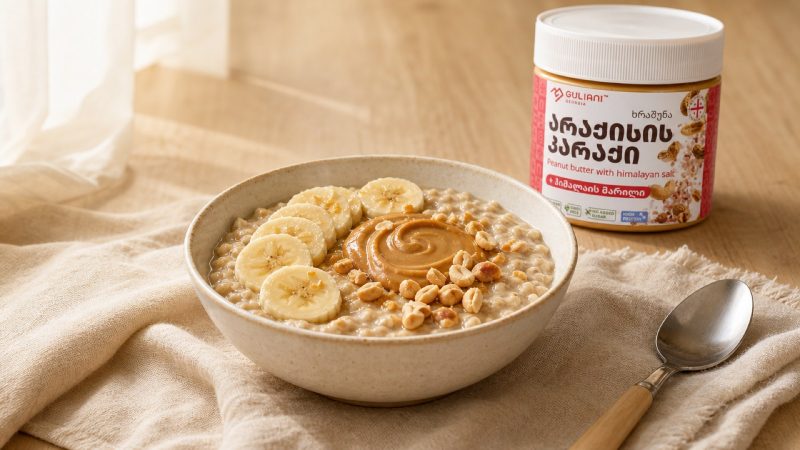
Eat it on rye bread, on a slice of mchadi, stirred into oatmeal, or straight from the spoon after a workout. The matsoni version makes a light, cooling summer breakfast. To work out exactly how many calories and how much protein your spoon of peanut butter gives, use the nut butter nutrition calculator.
The protein boom won't last forever: balance without obsession
FoodNavigator writes that high protein has moved from a gym niche into nearly every food category. It warns companies to plan for when demand cools [4]. Meanwhile, shoppers are taking a harder look at protein claims [2].
Our advice is simple: watch trends with curiosity, but don't turn your table into a numbers race. The Georgian table is varied enough already: a spoon of real peanut butter at breakfast, khacho, matsoni, lobio, vegetables. You'll find calories for Georgian dishes and ideas for a balanced plate in our Healthy Table section.
If you want to try the khacho cream, start with Peanut Butter Classic. A 350 g jar costs 15 GEL, and from 2 jars you get 20% off the whole order. You'll find more ideas in our recipes.