“კალორიების დღიური ნორმა”, daily calorie needs, is something a lot of people search for in Georgian, and the search often lands on our calculator [1]. People also look for a “calorie calculator” [2]. So we decided to explain it the way you would at a kitchen table over a cup of tea: where this number comes from, how it is calculated, and why it should never turn into a verdict. No formulas to memorise: the calculator does the maths, and we will follow three familiar characters.
What daily calorie needs are and where the number comes from
A calorie is a unit of energy: what we get from food and what we spend on everything, from breathing and walking to hoeing the vegetable patch and Saturday football. Your daily calorie need is an approximate figure for how much energy a particular person needs per day to keep their weight roughly where it is. The key word is “approximate”.
Our daily calorie calculator works this number out with the Mifflin–St Jeor formula. It shows how many calories you need to maintain, lose or gain weight, plus a split of protein, fat and carbs and your body mass index (BMI).
The Mifflin–St Jeor formula in plain words
The formula asks only a few things about you:
- Age: in the formula, the number slowly goes down as the years add up.
- Height and weight: the bigger the body, the more energy the formula allows for.
- Sex: the formula is slightly different for women and men.
- Activity: how much you move in a normal week, whether you sit at a desk, walk a lot or do physical work.
First the formula estimates what the body uses at rest, then it multiplies that by an activity factor. Your only tricky job is to pick your activity level honestly. The temptation is real: one workout a week and suddenly you feel “very active”. It is better to think of an ordinary week, not your sportiest day.
Let's calculate together: three examples from Georgian life
Nino, a student from Kutaisi
Nino is 20, walks to her lectures and spends evenings with books and a laptop. In the calculator she enters her age, height and weight and chooses light activity: there is walking, but most of the day is still spent sitting. Her young age pushes the number up, the seated hours keep it moderate. During exam season, when she barely leaves the library, her need will be lower than in summer, when she hikes the Baghdati forests with friends.
Giorgi, a weekend-football dad
Giorgi is 42, spends five days in an office and plays five-a-side with friends on Saturdays. His trap is well known: after the match he feels the whole week was “active”. The honest choice is light activity, because five days are spent at a desk. His height and weight put his number above Nino's, his age pulls it down a little. On match days Giorgi can eat a bit more, which is simply common sense.
Grandma Lamara and her garden in Tskaltubo
Lamara bebo is 68 and cannot imagine a day without her garden: hoeing in the morning, watering in the evening, picking cucumbers and tomatoes. Her age lowers the number in the formula, but the garden is real activity, so choosing a moderate level in summer is fair. In winter, when the garden rests, it is wiser to lower the activity level and recalculate.
Three people, three different numbers, and none of them is “right for everyone”. That is why there is no point in borrowing a neighbour's figure or one from the internet: you need to calculate your own.
Fitting in khachapuri, khinkali and a spoon of nut butter
Once you know your number, the fun part begins: how much room your favourite dishes take up in the day. Our section Calories in Georgian dishes calculates figures from typical home recipes, so they are approximate:
- Adjarian khachapuri: about 1202 kcal per 370 g serving;
- Imeruli khachapuri: about 586 kcal per 200 g;
- Khinkali: about 615 kcal per 300 g;
- Lobio: about 425 kcal per 250 g;
- Ghomi: about 206 kcal per 250 g;
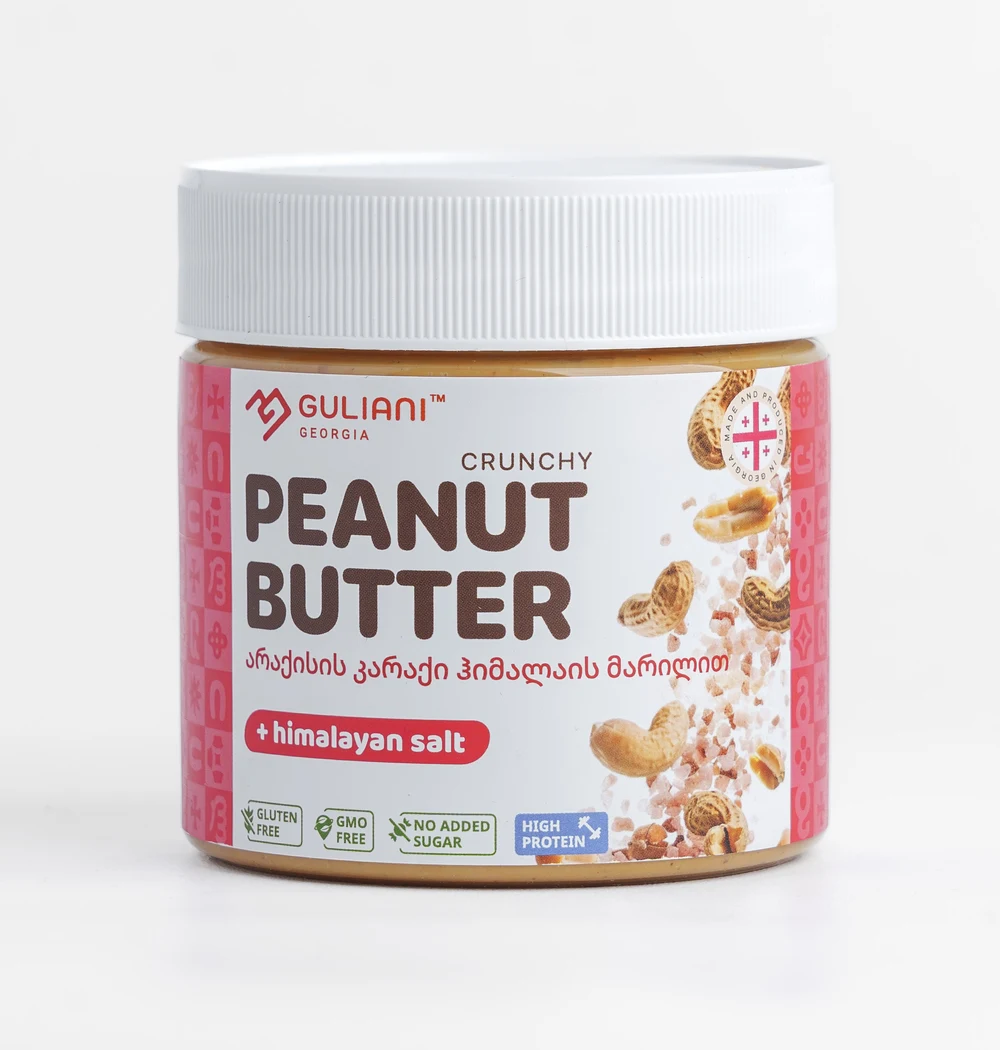
- Peanut Butter Classic: 232 kcal and 9.6 g protein per 36 g portion.
So one Adjarian khachapuri equals roughly five portions of peanut butter, and a serving of khinkali almost three. Divide the dish's figure by your daily number and you will see what share of the day it takes. For Nino, an Adjarian khachapuri is a sizeable part of her day; for Giorgi on match day, a smaller one. Nothing wrong with that: you simply plan the rest of the day more lightly, with ghomi, lobio and vegetables from Lamara bebo's garden.
GULIANI's founder shares his own routine: “I eat about 50–60 grams of peanut butter every day. That's more than the daily portion, because I train intensively, and it helps me get enough calories and refill my body with energy.” In other words, the same spoonful can be too much for one person and just what another needs. It all depends on your number and your day.
And one more important thing, in his words: “We don't count calories at a festive table. Sometimes you can overdo it a bit :)” Nobody weighs mtsvadi in grams at a wedding, a birthday or on New Year's Eve, and nobody should.
Why the number is a guide, not a verdict
- It is an estimate, not a measurement. The calculator gives you a starting point from which to observe yourself.
- Dish figures are approximate too. Grandma's khachapuri and a restaurant one are not the same: different amounts of cheese and butter.
- Don't stop at calories. The calculator also shows protein, fat and carbs. For example, Peanut Butter Classic has 9.6 g of protein per portion and Almond Butter 7.6 g.
- Common sense is the best calculator. Hunger, sleep, mood, season: no formula can count those.
The number is a map, not a strict teacher. It helps you know where you are, but it does not forbid grandma's khachapuri or khinkali with friends.
Where to start
First work out your need in the daily calorie calculator, then build a plate in the calorie calculator, which includes Georgian dishes. Curious how many calories and how much protein are in your spoonful? Check any portion with the nutrition calculator. Peanut Butter Classic is just roasted peanuts and Himalayan salt; a 350 g jar costs 15 GEL, and from two jars you get 20% off the whole order. For ideas, browse our recipes.